PETRAEUS: US VIOLATED GENEVA CONVENTIONS


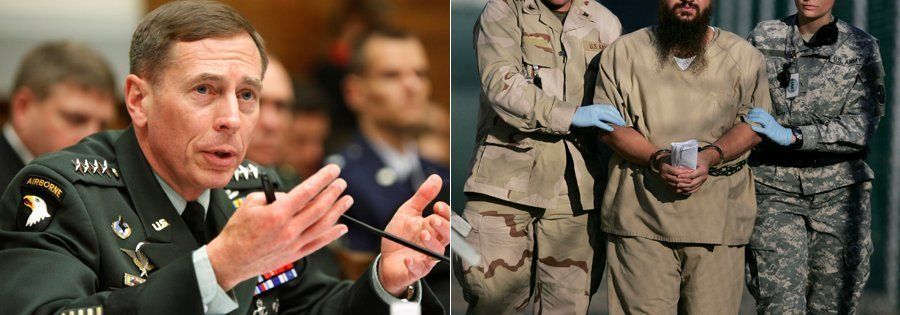
A couple of days ago, I chronicled the quickening departure of some big military names from the Republican party, those concerned about the party moving even farther to the right a number of issues, including torture. What struck me at the time is that General David Petraeus came out against torture and for closing Guantanamo.
I was stunned, however, when he admitted today that the United States has violated the Geneva Conventions. Without saying specifically how we did (though it doesn't take much imagination to figure it out), Petraeus said on FOX News:
Question: So is sending this signal that we're not going to use these kind of techniques anymore, what kind of impact does this have on people who do us harm in the field that you operate in? Gen. Petraeus: Well, actually what I would ask is, "Does that not take away from our enemies a tool which again have beaten us around the head and shoulders in the court of public opinion?" When we have taken steps that have violated the Geneva Conventions we rightly have been criticized, so as we move forward I think it's important to again live our values, to live the agreements that we have made in the international justice arena and to practice those.
This fits in very well with an explosive new video put out by VoteVets.org today, in which Jay Bagwell, who worked in counterintelligence in Afghanistan not only argues against torture, but says that detainees were brought in who had pamphlets portraying Guantanamo in them.

One has to wonder what Dick Cheney, Rush Limbaugh, and their crowd will say to this? In the past, General Petraeus could do and say no wrong. Now, he is not only saying torture does not work, but is saying that what the right fringe believes are only "enhanced techniques" violated international law.
As Jay Bagwell in our video says so well, "The Unites States can't be a beacon of freedom and human rights and the value of law while we ignore international law."
Now, we can say without a doubt that General David Petraeus agrees.
Mr. Cheney? Rush? What do you say to that?

READ MORE - PETRAEUS: US VIOLATED GENEVA CONVENTIONS

The Answer is Blowing in the Wind


Magnolia Plantation, Charleston, SC

Photo unrelated to entry. As usual.

Each year in Shillong, the quirky hillside town I grew up in north east India, Bob Dylan's birthday is celebrated in grand style. He has never been there but when he is ready, I'll take him home and introduce him. My brother lives there still and he would have a grand welcome. I attended St. Mary's, the school mentioned in the article. How fun is this? Very fun.

Shillong singer keeps Dylan legacy blowin' in the wind

Published: May 23, 2009, 23:50
Shillong: The sunlit hall of the local St Mary's College for girls in this picture postcard capital of Meghalaya sways to the chants of Forever Young - a signature 1974 Bob Dylan track.

An aging musician with stained teeth, long hair and childlike smile strums his guitar and eggs on nearly 500 schoolgirls to join the chorus. Everyone carries placards proclaiming "Happy Birthday Dylan". It's a practice session for a Dylan's birthday concert today.

Meet Lou Majaw, the 62-year-old Dylan of northeastern India, who has been singing Bob Dylan's songs and improvising on them for the past 43 years.


Bob Dylan's Birthday Bash
Shillong: The birthday boy was missing but not the fanfare and the songs immortalized in the 60s were found still blowing in the wind. No other city, perhaps, has been celebrating Bob Dylan's birthday without a break for the past 38 years. And on Sunday, it was no different in Shillong.
READ MORE - The Answer is Blowing in the Wind

A weekend that moves mountains


Greg Barker, director of “Sergio,” accepts the Audience Choice Award from Mountainfilm Festival Director David Holbrooke at the festival’s closing picnic on Monday. [Photo by Merrick Chase]

‘Sergio’ is audience favorite at Mountainfilm

By Katie Klingsporn
Associate Editor
Published: Tuesday, May 26, 2009 8:45 PM CDT
The 2009 Mountainfilm Festival plopped its audience in front of gorgeous canyons and tremendous acts of bravery, audacious hoaxes and evil corporate maneuvering, boundless compassion and extraordinary individuals.

In the end, it was one of these individuals — Sergio Vieira de Mello — who stole the hearts of the movie-goers.

Greg Barker’s film, “Sergio” is a meticulously-crafted portrait of de Mello — the former United Nations High Commissioner for Human Rights whose life was cut tragically short when a truck bomb exploded below his office in Baghdad. “Sergio” won the Audience Choice Award at this year’s festival.

The story, which is based on Samantha Power’s book “Chasing the Flame,” centers around the day the truck bomb detonated, rendering the UN building into a pile of rubble, with Sergio and others buried beneath. As it chronicles the incredible efforts by rescuers to dig him out, the film weaves in bits and pieces of de Mello’s tremendous life; a young revolutionary, a UN worker devoted to refugees, a charismatic Brazilian diplomat who had taken the position in Iraq despite his fierce opposition to the U.S. invasion of the country. The effect was devastating.


And at the end of the film, a surprise guest took the stage: Bill von Zehle, the special operations officer who fought so hard to save de Mello. If the movie didn’t have audience members tearing up, the sight of von Zehle did.

Greg Barker, the film’s director, offered a humble thank you to the crowd at Monday’s closing picnic, giving a special shout-out to von Zehle.

“Thanks to Bill ... the incredible hero of the film,” Barker said.

“Sergio” had its fair share of competition, as Mountainfilm brought a bundle of excellent films to Telluride this year. It stuck with its roots with climbing films like “Samsara” and “The Sharp End,” but the lineup was heavy on human rights, environmental and activist films, presentations and speakers.

It was one of these speakers who won the Festival Director’s Award: Tim DeChristopher, the 27-year-old University of Utah student who made headlines in December when he monkey-wrenched an oil and gas lease sale. That day, DeChristopher bought up $1.7 million worth of leases he never intended to pay for. He now faces up to 10 years in prison.

When he accepted his award, DeChristopher said: “Thanks for letting me know I’m not the only one willing to stand up for my future … that you are all with me.”


This year’s Moving Mountains Award, meanwhile, came with a surprise. The award, which is intended to go to one non-profit that is featured in a film, was reduced to $3,000 from $5,000 this year. But as judge and former Moving Mountains winner Ben Skinner explained to the picnic crowd on Monday, $3,000 just wasn’t satisfactory.

“This is the power to of a few committed citizens to change the world,” Skinner said.

The panel started chipping in, and as the word leaked, the prize money grew. In the end, these judges were able to award a $5,000 prize to two recipients: Democratic Voices of Burma from “Burma VJ” and Dr. Rick Hodes from “Making the Crooked Straight.”

Hodes is the miracle-working doctor who works in Ethiopia caring for children who have cancer or are stricken with deformities as a result of tuberculosis of the spine. Hodes also adopts many of the orphans he encounters, giving them a chance at education and a healthy life.

When he accepted his award, Hodes said he has 150 kids who are currently awaiting spine surgery.

“You guys are going a long way in helping me change the lives of these kids,” he said.

The festival’s Food For Thought award was snagged by “Food, Inc.” an excellent portrait of America’s broken food system — from inhumane working conditions at vast slaughterhouses to Monsanto’s relentless litigation against small farmers to the way corn has sneaked into nearly everything we eat — soda, cookies, even meat.

The Charlie Fowler Award, meanwhile, went to “Samsara,” the athlete-produced film about climbers Jimmy Chin, Renan Ozturk and Conrad Anker, who trek to the heart of India to attempt a first ascent of knife-like Mt. Meru — and endure a whole lot of suffering trying to summit it.

And the Aspiring Filmmaker’s Award — decided by a panel of students — went to “Surfing 50 States,” a light-hearted film about a pair of charismatic Australians who come to the United States with a singular goal: to surf in every state.

Festival Director David Holbrooke said the festival kept with its tradition of inspiration, accessibility, warmth, optimism and infectious energy.

“I think the film quality was great, but I think it’s these intangibles that make such a difference,” Holbrooke said.

“Going into it I was kind a little anxious,” he said. “The airport was closed, the road was torn up, there was dust in the mountains... But once it got rolling it really rolled.”
READ MORE - A weekend that moves mountains

Access to Facebook restored in Iran

Tehran - Now Iranian’s can access Facebook, the popular social networking site. Iran’s judiciary restored access to Facebook on Tuesday. The popular social networking site was blocked Saturday. After the blocking of the social-networking website led to a heated debate in Iran’s presidential campaign.
facebook
facebook
According to news agency ILNA, the social networking site had been blocked after a decision “by a committee of representatives from the ministry of interior, intelligence, judiciary, parliament and some other ministries.” The news agency added that the decision was taken because “supporters of Mir Hossein Mousavi were using Facebook to better disseminate the candidate’s positions.”
Mir Hossein Mousavi is considered as the main rival to conservative President Mahmoud Ahmadinejad who is seeking a second term in office in next month’s election. At an news conference on Monday, Ahmadinejad rejected the charges and promised to make inquiries with the judiciary for restoring access to the site.
Facebook is one of the most popular websites in Iran, where the number of its members has increased dramatically, reportedly to 150,000. According to figures from the communication ministry, the number of internet users has increased to 23 million out of a total population of 70 million Iranians.
READ MORE - Access to Facebook restored in Iran

Istanbul art scene

The rise of Turkish contemporary art

As the financial crisis further limits their options, buyers are looking to one long-neglected — and surprisingly current — market.

By Nichole Sobecki
ISTANBUL, Turkey — Home to an acclaimed biennial and several world-class galleries, Turkey has long nurtured a strong contemporary art scene, influenced as much by modern Turkish politics and society as by the country's Ottoman past. Its diverse range of artists reflects the sometimes contradictory positions of Turkey itself, cast as the gateway to both Europe and Asia.
In today’s economic climate, as many an artist sweats over the contracting international art market, Turkey has emerged as a surprising success story.
Since the year's end, buyers have been circumspect, some galleries have closed and contemporary art values have dropped by a third. Expectations for the upcoming spring auctions are far less ambitious than previous years, with Sotheby's expecting to bring in between $179 million and $256 million, down from $742 million last spring.
But for emerging markets such as Turkey, it seems that shrinking pocketbooks are drawing Western buyers towards previously neglected art communities.
This past March, Sotheby’s in London held its first major auction dedicated to Turkish contemporary art. The auction was part of a Sotheby's strategy to establish a foothold in frontier markets, following the first Arab and Iranian modern and contemporary sales in 2007.
Works fetched a wide range of prices: Among the least expensive items was an untitled painting by Erdogan Zumrutoglu, which sold for $5,685; “Spiritual,” by Taner Ceylan, fetched $107,415; while at the upper end, an untitled oil on canvas by Orhon fetched 193,250 pounds, or $292,870. A total of 50 pieces was sold for 1,349,500 pounds, or a little more than $2 million. Despite increased foreign interest, most of the buyers were Turkish collectors.
GlobalPost recently sat down with Isabella Içöz, an adviser to Sotheby’s on Turkish contemporary art:
What first drew you to Turkish contemporary art?

Actually, it was originally my circumstances that made me have to become interested in Turkish contemporary art. My husband is Turkish so I moved here two years ago. Before that I’d been working in art for about seven years, primarily at Christie’s in London. When I knew I was moving to Istanbul, however, I began to inform myself about Turkish contemporary art internationally and found that there was very little information available and very little Turkish art in international collections. That interested me, especially because I think the art here is so good and I really didn’t understand why there wasn’t much dialogue externally.
Then, especially in the last two years, you really see a huge growth in Turkish contemporary art. You have numerous museums that have been built, independent art spaces, a lot of galleries have started to appear and now you have some major Turkish artists in important international collections. You have someone like Hale Tenger in the Centre Pompidou, Selma Gurbuz in the Tate Modern. You also have artists like Kutlug Ataman being short-listed for the Turner Prize.

What are the defining characteristics of the contemporary art scene in Turkey?
READ MORE - Istanbul art scene

Courage to be free

Anand Patwardhan speaks lucidly through his films and in person, an observation that makes Joshy Joseph return to the director’s works time and again to measure the actual height and weight of Indian history

IT happened during the 1988 International Film Festival of India held in Trivandrum. I was trying to persuade Anand Patwardhan to accept the first copy of a book on Malayalam cinema at an official ceremony from Derek Malcolm, The Guardian’s reputed film critic. The author of the book was a friend of mine. Anand agreed to accept the book, but not without asking me, “Why Derek Malcolm? Is it because he is a white man?”
Many years later, when Films Division interviewed Anand for a curtain-raiser film on Films Division for the Mumbai International Film Festival (for documentary, short and animation films), I heard him say, “Luckily, we need not refer to Ben Kinsley as Gandhi, since FD has the original Gandhi footage!”
Anand speaks so lucidly through his films and in person. That is why, even while working for an official documenting agency, I always go back to Anand’s films to measure the actual height and weight of Indian history. Anybody who attended that edition of the MIFF at the NCPA in Mumbai, where Anand’s film Ram Ke Naam was screened and stood out in sharp contrast to the official version of the Ayodhya issue, would understand me better.
Every time I wake up for a sunrise shoot or patiently wait to capture a clear-sky sunset shot, I cannot help envying Anand. I cannot recall a single “beautiful shot” in his films ~ a shot devised for the sake of achieving beauty. It is the political conviction that illuminates his skies without bothering about the acceptibility factor, that strikes me over and over again. It is not for nothing that his films have so confidently withstood the test of time. And about the wrath of nervous officialdom towards him and his films, it is only a cinematic addition to the good old stories of flourishing court poets juxtaposed with one or two poets of destiny.
In Kerala, experienced farmers always advise us not to buy spotless vegetables from the market. They tell us that naturally-grown vegetables normally have spots on them. In a supposedly advanced method of cultivation, systemic insecticides are fed to the plants as they grow, unlike the general practice of spraying pesticides. That is why they are called “systemic insecticides”. So, any insect that touches the plant, dies on the spot! And the vegetables and fruits remain spotless, like the glossy images in advertisement films!
Once, in the course of an MIFF selection process, Anand’s film on the fishermen’s issue was rejected on the ground of “bad image quality”. The chairman of the selection committee was a Hindutva element in disguise who had, wonder of wonders, no difficulty in choosing his own film for the festival! Anyway, the list of selected films reached me through a colleague who was visibly upset at the turn of events and chose to confide in me. He asked whether something could be done in the matter.
I immediately relayed this information to a daredevil friend of mine who was on the staff of The Sunday Observer, a now-defunct weekly paper. It was a Saturday evening. Overlooking space and deadline constraints, they flashed the story the next day ~ “Miffed Patwardhan withdraws his film”. The story, or rather the strategy, worked ~ Anand’s film was included on Monday.
Later, when we met at a cocktail party, I said “cheers” to the selection committee chairman. And then murmured in a lighter vein, “You are Vinod and he is Anand, both meaning joy. Now enjoy.”
Changing to a serious note, I asked why the film had been rejected. In some sequences, according to him, the visuals were very grainy. He knew that in the capital of sleek Hindi commercial cinema and corporate advertisement films, “the image quality” bit could be used as a ready-made purdah to conceal the actual facial expression in the presence of truth.
Recently, in a court battle over the Mumbai bomb-blast case, one party requested the court to view Anand’s Father, Son and Holy War to get an idea of the conditions then reigning in the city before arriving at any judgment. Whether the court admitted the plea or not is not the point. Rather, the point is that in a case which involves a gun-toting Hindi film star, the reference point of facts was an Anand Patwardhan film. When countless crores of rupees go down the drain to project the pelvic thrusts and the dishum-dishum of constipated poster boys, Anand’s investment is his political conviction expressed by means of a precise aperture that records vital twists and turns of contemporary history.
Anand’s film, War and Peace, is an epic documentation of how violence is perpetrated and is being perpetuated in the name of patriotism. The film unforgettably unveils whipped-up mob frenzy through bombastic speeches of politicians and their heady narratives of nationalism. A cunning master-narrative is woven into this, which acts as an eyewitness and an argumentative self at the same time. The film encompasses the viewer, too, for almost three most fruitful hours; thus, the unity of trinity becomes a complete experience. This is masterpiece cinema.
War and Peace gets into the interiors of two nations ~ India and Pakistan ~ as if in a laparoscopic operation. Even as the right-wing political party then in power kept puking vehemently, Anand’s camera surveyed the body politic with remarkable surgical precision. They wanted to restrain him by asking him to remove even the film’s reference to Gandhi’s assassination. Hey Ram! Gandhi never got assassinated in this country!
I have a feeling that Gandhi knew why Bonsai plants don’t grow tall. When seedlings, root cuttings and small grafted plants are to be developed as Bonsai, they are first cultivated in ground beds. Here, the branches and root tips are pruned repeatedly. Each pruning helps the plants to develop “dwarfing” habits.
State-of-the-art pruning of political documentaries in India happens today more in the avenues of huge inflow of international capital through funding agencies and the pitching sessions they organise, than in the public-sector sphere. This will become clear if one watches and analyses the kind of projects that are backed by the European Documentary Network and its offshoots like STEPS India.
In portrayals of marginalised individuals, or dushtu-dushtu, mishti-mishti analyses of Kashmir or the North-east, you won’t find a junior Anand Patwardhan anywhere in the picture. No wonder these pitching film-makers are often to be found bitching eloquently about Anand and his ouevre. They say Anand’s films are very functional and lack spiritual dimensions. So, to remedy the situation, they go out into the world and try their desperate best to discover the exotic “other”.
Vaikkom Mohammad Basheer, the great Malayalam writer, wandered all over India for many years in search of truth. One of his incarnations was that of a sadhu in the Himalayas. Explaining why he quit being a sadhu, Basheer said some people would collect firewood, split it into smaller pieces and use these to start the kitchen fire. These people would not ask Basheer to share in the work; “Just meditate without distraction,” they would say. But Basheer still used to get distracted ~ the very arrangement of avoiding distraction distracted him.
Indian documentary today is taken seriously by the world because yesterday an Anand Patwardhan happened here. Your “spirituality” became possible due to the “physicality” of Anand Patwardhan’s films. I don’t have to reserve these words for an obituary.
I would like to recall another incident at the MIFF. Anand was secretly summoned by the organisers just before the awards ceremony to select a two-minute excerpt from his film which had won a prize. The clip was to be screened at the awards function. Then Maharashtra chief minister Manohar Joshi was the chief guest and he would hand out the prizes. Just when a sequence from Father, Son and Holy War was being shown on the screen where Joshi ~ now on stage in a full-sleeved black safari suit ~ was asking for the blood of a minority community, Anand’s name was called out to receive one of the awards. While the audience cheered, Anand, dressed in his usual kurta-pyjama, shook hands with Joshi and received the award. Anand is an undomesticated political animal.
The sharp edges can be flattened with awards, awards and more awards. But, mercifully, the laws of the market do not apply to Anand. I have always respected him for consciously distancing himself from those “dwarfing habits” about which I have spoken earlier.
READ MORE - Courage to be free

American Idol 2009 -- If I'm Being Honest

Wow! What an upset! Kris Allen won. The All-American fresh-faced boy next door beat a theatrical guy who wore leather and eyeliner. Who knew??? This country is not yet ready to crown a young man who looks like Liza Minnelli their next American Idol. Not that Kris didn't deserve it but clearly Adam was the more interesting, original choice. And I suspect will have the greater career (whatever that means). They could both be stars or in five years one could open for the other at Magic Mountain.
Still, it was Adam who jump-started the series. He's the one everybody was talking about, he's the reason you watched every week. My guess is all those tweenage girls who were so shattered last year when David Archeletta lost vowed they would never let that happen again. Hell hath no fury like a middle schooler with a Twitter account!
Of course the real winner here is American Idol. People will be talking about this for days.
I felt bad for both of them on the final performance night having to sing that insipid song co-written by Kara DioGuardi.
Go farther and deeper and don't give up your dreams, there are no boundaries, climb every mountain, spread your wings, reach for the stars.
Those lyrics might inspire Mike Tyson to bite someone's ear off but otherwise they're nothing but a string of tired clichés. And the person who co-wrote that drivel is telling other people they're not artists?? Mark my words: after this week you'll hear "Letter to my Teenage Son" by Victor Lundberg on the radio before you ever hear "No Boundaries." More on Kara later.
Here are my overall thoughts on this season. And please understand that I'm a fan of the show. At one time I loved it. It was the perfect blend of music, controversy, and stupidity all wrapped into one highly entertaining hour of live cheese. I just think they've gotten off the track.
American Idol has become American Airlines. You get far less for your money and it takes much longer to get to your destination.
In a Fox effort to get as much as they can out of their one cash cow (Sit Down, Shut Up never panned out as the national phenomenon they expected) I'm sure they put pressure on Idol to expand as much as they could. Y'know, a half hour here, fourteen hours there. But with no real new program content what we were left with was cocaine cut so thin it would pass a Major League Baseball drug test.
All of the "improvements" this season were designed to pump more air into the already stretched balloon. Adding a fourth judge. Good God, why? Two of the ones they already had were as useless as highway signs in Braille. Then, to compound matters, they hire a woman so annoying, so whiny that I find myself preferring the sound of a car alarm. And she's still a better judge than songwriter.
Another "improvement" was to expand Hollywood week. They took 300 hours of Hollywood auditions and edited them down to 298 hours of airtime. Topped off by an entire night of kids stepping into an elevator that led to their doom. So much for follow your dreams, reach for the sky, etc. There may be no boundaries for Kris, but for the other 99,999 there definitely are and the sign at the border read KEEP OUT.
Once the live broadcasts began the show started to show some life. We were treated to actual performances. 90 second snippets that passed for songs but still! Of course we were now two months into the season already. (Compare that to 24 where by week eight more people had died than in World War I.)
This is the "psychopaths and opportunists on parade" portion of the festivities. Topping this year's crop of loons was Tatiana Del Toro who was so off-the-charts obnoxious that Kara was tolerable. It's like when your face is on fire you tend to forget that your tooth aches.
Here again, the producers' "improvements" allowed whackjobs like Tatiana to just keep coming back, much like the Terminator or floods. The problem is after eight seasons we've become so conditioned to the freaks and losers that there's nothing surprising or even entertaining about them anymore. So Tatiana on her knees wailing and groveling for one more chance is now as heart wrenching as the TV Guide program crawl.
Finally the Top 13 was selected (in previous years it was the Top 10). This gave producers the opportunity to stretch the show to two hours or more for weeks. Mentors were once again enlisted. Vocal advice from such noted singers as guitarist Slash, film director Quentin Tarentino, and actor (with a movie conveniently just opening) Jaime Foxx. Were fellow crooners Dick Cheney and Roseanne unavailable?
When they finally had to limit the performance shows to an hour it was like squeezing a Minnesota Viking into Nicole Richie's leotards. First the judges had to team up and that was a disaster. Silence Simon so Kara could question everyone's "artistry". The cardinal rule of show business: You never replace Curly with Shemp if Curly is still alive.
Results shows that used to be a half hour swelled to sixty minutes. So there were now 58 minutes of shoe leather rather than 28. The rest of these hours were filled with former American Idols hawking their new singles (a Taylor Hicks pity booking), Ford commercials (they're zany these kids!), recaps of recaps, Up With People production numbers that transformed the tattooed contestants into Osmonds, and plugs for iTunes, tours, video downloads, their website -- pretty much everything short of Paula's jewelry line and bottles of Mighty Mendit.
But unlike past years, the caliber of contestants (once you weeded out "Bikini Girl" and the future Mickey Rourkes) was much higher this season. Adam, Danny, or Allison could have easily beaten the "Soul Patrol", Jordin Sparks, or ",the Velvet Teddy Bear (Ruben Studdard -- see how fast we forget?). All the more reason to be frustrated when performances were truncated so Randy had time to say "mad vocals" fifteen times a show instead of nine.
So congratulations to Kris. And Adam, who will probably get even more notoriety for losing. Most of the others from this year's crop will fade into the mist although Tatiana will surely resurface if they ever do a remake of SYBIL.
There's a rumor that next year Fox plans to expand the show even more. This ranks up there in hubris with ticket prices at the new Yankee Stadium. I hope it's not true and I'll just conclude by reminding you of that one great truism of Broadway.
"Cut out twenty minutes and the show will run for two more years."
Tryouts for next season begin soon. Eagle scouts only need apply. It's been fun reviewing Idol for HuffPost. See you in January.
READ MORE - American Idol 2009 -- If I'm Being Honest

The Afterlife of George W. Bush


The Simple Life: Bush on the way to his Dallas home

By Bill Minutaglio

Patrick Bibb, a 19-year-old from Dallas, glanced at his cell phone. He was in the middle of his economics class at Texas Christian University on a February morning. His caller ID read withheld. He decided not to answer. When class ended, he checked his messages and found that George W. Bush had been trying to reach him.
The sophomore listened to the voice mail. He heard the former president of the United States thank him at least four times. Bush was happy that the teenager had been selling welcome home george & laura signs for $20 to people all over Bush's neighborhood in Texas. "I hope this message is sufficient" to show appreciation, Bibb heard Bush say. Bibb dutifully listened, hung up and went to his other classes.

Bibb, a budding entrepreneur, had decided to make and sell the signs after he learned that the former president would be moving close to his parents' house. The placards went up all around the exclusive Preston Hollow neighborhood in North Dallas, which is studded with homes worth $5 million to $20 million. Bibb used some of the profits to pay his tuition and decided to donate the rest to a nearby elementary school.
He settled into accounting class. His phone rang again. Bibb decided to pick up. "Excuse me, I need to go to talk to the president," Bibb wisecracked to a pal as he left the room. It was Bush again.
He began thanking Bibb, repeatedly, for making the signs. Bibb listened patiently. He didn't mean to be rude, but he finally said: "I'm really sorry, Mr. President. I'm in the middle of class." He needed to get off the phone. Bush replied: "No problem, that's where you're supposed to be."
Weeks later, the undergraduate was still wondering about his chat with the man who, only a short time ago, was arguably the most powerful man on the planet. "I had just wanted him to know that people still cared about him, despite the public-opinion polls," says Bibb.
Bibb's not the only one. Molly Vilbig, who lives nearby, believes Bush had gotten word that her grandson had once tried, at the tender age of 6, to donate $1 to the first Bush for President campaign. That's why, Vilbig suspects, the ex-president called and invited the 14-year-old to come over. Under the watchful eye of Secret Service agents, the boy walked to Bush's home. The two settled into chairs in the backyard. "Ask me anything you want," Bush said to the boy, according to the grandmother.

They spent 90 minutes together. And when the teenager went home, he told his grandmother all about it. She was Republican, as were many of the folks in the neighborhood. In the following days, she saw her grandson getting chummy with the Secret Service agents on the street. One day she called Jake to dinner. He came in, a little upset. "I was just about to learn Laura Bush's Secret Service code name," she heard her grandson say.

Bush has always been friendly. And maybe, after years of being cordoned off by security, his face time with others carefully choreographed and his days scheduled to the hilt, it's refreshing to him just to have the chance for a spontaneous chat with a neighbor. But Bush's choice of conversational companions may speak to something deeper. He lived in a bubble during much of his time in Washington; having left office with a disapproval rating of 73 percent, he might be forgiven for being a bit hesitant about what awaits him on the outside. He's declined to give a major interview since leaving office (he and his aides declined to cooperate with this story). So Bush seems to be easing into life back home in Texas, reaching out quietly to reconnect with old friends, stalwart supporters—and the occasional teenage fanboy, who may or may not yet be fully aware of the harsh public judgments, even in Republican circles, of the guy who just moved in next door.

"He is in home territory for sure, no question about it. And that's where he wants to be," says Bruce Buchanan, a presidential scholar at the University of Texas at Austin. "He doesn't enjoy naysayers and critics and opposition. Never has. And right now, he needs that nurturing cocoon that he is in. He is not calling people who didn't support him. He is calling people who supported him, those 14-year-olds."

"But we will see how serious he wants to get in being a participant in the debate over his legacy, beyond writing his side of the story," Buchanan continues. "He may decide, forget it. Or he may decide to become his own version of the Jimmy Carter model. Or he might just stay on the lecture circuit and make money. He has all those options."

And he's exploring them, to be sure. Bush made his first foray into the lucrative post presidency speaking circuit last month, cracking up an audience of Calgary oilmen for a reported $400 a ticket. He's got more talks ahead, including one with former president Bill Clinton in late May. He's busy writing a book and aggressively raising money for a $300 million library, museum and think tank on the campus of Southern Methodist University. And he's trying to find his place in Texas, a land where he once was king.

When Bush flew home from Washington Jan. 20, he made a very safe bet. He landed in Midland. His friends are among the most prominent figures in the small, affluent west Texas town. It's where he was raised, where the family name carried serious weight. It's where Laura Bush, whose approval ratings were nearly twice her husband's when they left Washington, comes from. "They turned out 30,000 people here," says his longtime Texas accountant, Bob McCleskey. "And that's without giving out food and beer. Most people in Texas, by and large, hold him in high regard because he made a decision and stuck with it."

Those Texas friends say Bush seems remarkably unchanged by his eight years in Washington. "Every time I talk to him or have been around him, he has been very upbeat," says his buddy Nolan Ryan, the baseball legend Bush has described as his "hero."
Quantcast

Ryan helped orchestrate one of the rare public appearances Bush has made since leaving office. In April, Ryan, now the president of the Texas Rangers, invited Bush, once a limited partner in the team, to throw out the first pitch of the season. "He was well received," says Ryan. "It was a very positive day."

Ryan knows a little about stepping off the mound. Leave office, Ryan says, and "you're just another citizen of the United States."

When Bush last lived here full time, he was a media darling with sky-high approval ratings. Karl Rove had conducted a "front-porch campaign," inspired by the candidacy of William McKinley. Governor Bush waited for national GOP leaders to come to him at the stately white-columned governor's mansion in Austin. Republican rainmakers trooped up the steps and threw their support to Bush's presidential campaign.

Today, the mansion is in ruins—almost torched to the ground last June by an arsonist who still hasn't been caught. And the Bush brand, once spoken of in the halls of the legislature with awe, is now a little like Lord Voldemort's. "It is the name that shall not be spoken," says Texas political consultant Bill Miller, who has worked with both Democrats and Republicans. "The emotional response from people is almost always negative, never positive. It's a different time and a different deal."

Earlier this year a state lawmaker from Waco, which is close to Bush's ranch, proposed a bill praising the ex-president as a man who "lived each day with the safety and prosperity of his fellow citizens foremost in his mind; he took a principled stand on a wide range of issues of great importance to every American, and his tireless efforts will not soon be forgotten." Further, the measure held that Bush should be lauded for his "new antiterrorism tools."

It was similar to the thousands of salutes handed out every year without a whisper of opposition. But this one met with intense resistance by one Ft. Worth state representative, who said it seemed like Bush was being congratulated for "his waterboarding and other torture techniques." The original proposal was withdrawn, rewritten and resubmitted. At the last hearing on the bill in late April, no witnesses showed up to defend it or attack it. It now sits in limbo—a little like the person it was written for.

Only a little more than a month after leaving Washington, Bush dropped in to see students at Pershing Elementary near his new house in Dallas, according to a local blogger. He asked the grade-schoolers if they knew who he was. One student shouted: "George Washington!"

He quickly answered: "George Washington Bush."
Quantcast

Texas today is different from the heady place it was when Bush left. Unemployment is rising, and deepening recessions are predicted for some urban areas. And though it is still firmly a Republican state, the GOP holds just a two-seat lead in the Texas House. Obama secured 44 percent of the vote in Texas, improving on the 38 percent Kerry won when he ran against Bush in 2004. Navigating the changed terrain is tricky business for Bush and his handlers—one that involves carefully picking his spots.

There has been resistance to the policy institute, or think tank, he's seeking to establish at Southern Methodist University. Critics see it as a place designed to burnish the Bush legacy, glossing over problems—and wounding the school's academic independence in the process. Defenders say it will be a forward-looking organization devoted to examining 21st-century global concerns.

A state district judge ordered Bush to give up to a six-hour deposition in a civil lawsuit claiming that SMU officials broke the law when they acquired and tore down a condominium complex to make room for his center. Bush's lawyers say they will appeal, and legal observers say it is highly unusual for sitting or former presidents to be compelled to testify in litigation.

Meanwhile, Bush has talked to a political-science class at SMU, worked out at the school's training facilities and met with old hands to plot strategy for his presidential center. "It seems that former president Bush is always on campus," says student-body president-elect Patrick Kobler. "Though I may not agree with every policy he put forth, I believe that he led from the heart, meaning he looked beyond what was considered popular and instead did what he thought was right."

He has set up an office in North Dallas, where, friends say, he is deeply enmeshed in his memoirs. The book will revolve around key decisions of his presidency—and of his life before Washington, such as when, at 40, he stopped drinking. "I know he is working on his book," says billionaire Tom Hicks, his longtime friend. "I get the sense that he has the confidence that history will judge him a lot better than The New York Times or the current media does."

Hicks, who made Bush a wealthy man by buying the Rangers from his ownership group, helped the Bushes get settled in their spot on Daria Place—right next door to his estate. Another Texas billionaire, Harold Simmons, a major player in the world's titanium supply, is nearby; Simmons helped bankroll the Swift Boat campaign against John Kerry. The men who helped give Bush the platform, the money and the political muscle to win his various campaigns are within easy walking distance of his new front porch.

Fred Meyer, former chairman of the Texas GOP, was on hand at Ellington Airport in Houston when Bush's father came home. "And there were not a lot of us there," Meyer says, contrasting the reception with the "gang" present for 43's return. An ailing economy had dampened enthusiasm for the father. But 41's approval ratings had rebounded to 56 percent by the time he jetted to Houston, and he was buoyed by the many friends he'd made over the course of a long career. Larry Temple, formerly special counsel to Lyndon Johnson, says the vibe surrounding 43's return is different. "I see people reliving [George W.] Bush's presidency. There is a lingering dissatisfaction. It may be the war, it may be the residual effects of the economy," he says.

"Presidents don't get a full and fair hearing until everyone who was alive when they were alive is dead and so are they," says UT's Buchanan. It will take time.
Quantcast

The waiting must be hard on Bush, a man still bristling with a jangly, kinetic energy at 62. One day in Dallas, according to a local blog, he visited Pershing Elementary and a parent asked him to consider coming to work at the school's haunted-house carnival.

"I'd make a good ghost," Bush replied.
WithAnne Belli Perez

Minutaglio, the author of First Son: George W. Bush and the Bush Family Dynasty, teaches journalism at the University of Texas at Austin.
READ MORE - The Afterlife of George W. Bush

Dozens dead in Indonesia air crash

The Hercules transport plane was believed to be carrying more than 100 passengers and crew [AFP]
At least 93 people have died after an Indonesian military transport plane crashed into a village in East Java, air force officials have said.
The crash, during what the military says was a routine training mission, occurred on Wednesday morning near the town of Madiun in the Gaplak district of East Java.
The C-130 Hercules aircraft, carrying more than 100 passengers and crew, crashed into several houses on the ground before skidding into a rice paddy field sending flames and billowing smoke into the air.
Footage shown on Indonesian television showed burning wreckage strewn over a rice field with only the plane's tail remaining intact.
At least 10 children, the families of military personnel, were believed to have been on the flight.
Officials have said they expect the death toll to rise once they are able to sift through the wreckage.
Indonesian media reports said about 15 injured people had been sent to local hospitals, many suffering from bad burns.

Timeline
 Indonesia air disasters
The Hercules aircraft was flying from Halim airbase near Jakarta, the Indonesian capital, to a base near Madiun when it came down. The weather was clear at the time of the crash and investigations have begun into the cause of the disaster.
Explosions


An eyewitness named Tofa told Indonesia's Metro TV news channel that he had heard two explosions as the plane crashed in flames. He said local residents immediately ran to help pull passengers from the burning wreckage.
Other witnesses reported seeing the plane split apart in mid-air following a loud explosion.
Indonesia's air force has long complained of being underfunded and handicapped by a US ban on weapons sales, which  has recently been lifted.
The air force has suffered a series of accidents, including one last month involving a Fokker 27 plane that crashed into an airport hangar, killing all 24 on board.
Last week a Hercules aircraft lost a wheel after it overshot the runway as it came in to land in the eastern Indonesian province of Papua.
Recent years have also seen a series of deadly crashes involving commercial passenger planes, and Indonesian airlines are currently banned from European Union airspace over safety concerns.
READ MORE - Dozens dead in Indonesia air crash

KRF greets KNF, ZSF hails Thangso

IMPHAL, May 20 : The Kuki Revolutionary Front (KRF) has greeted Kuki National Front (KNF) on the latter’s 22nd raising day, conveyed a press release issued by information and publicity secretary of KRF Armstrong Gangte.

It also conveyed its wish that the KNF continue their struggle for a political solution to the issue of Kukis.

The KNF was formed on May 18, 1987 by late Nehlun Kigpen, it mentioned.


ZSF hails Thangso

Churachandpur, May 20 : Zomi Students’ Federation, the apex student body the Zomis today congratulated the newly elected MP from Outer Manipur, Thangso Baite and wished him a fruitful tenure during his stint at the Indian Parliament.

“The ZSF pray that God will guide him (Thangso Baite) in his endeavour so that he could administered to his people a sense of brotherhoodness, peace, harmony and development in the hill districts of Ma-nipur,” reads a statement issued by the federation today.

The statement also con-demned the incident that befelt upon Thangkhansuan Tunglut, Manager Small and Medium Enterprise, State Bank of India, Imphal at his residence on 18 May 2009. Instead of terro-rizing innocent civilians, the federation suggests that all concerned settle any disgruntle without any life threat in the future. It also appeals to all government heads and executive officers to execute their duties by any means in the interest of development.
READ MORE - KRF greets KNF, ZSF hails Thangso

The Nation: The Plight of Women Soldiers

 
Spc. Monica Brown
U.S. Army, Sgt. Jim Wilt/HO

Spc. Monica Brown received the Silver Star Medal at Bagram Airfield, Afghanistan in March 2008. Brown is the second female since World War II to earn the Silver Star award for her gallant actions while in combat. Pentagon policy prohibits women from serving in front-line combat roles, in the infantry, armor or artillery, for example. But the nature of the wars in Afghanistan and Iraq, with no real front lines, has seen women soldiers take part in close-quarters combat more than previous conflicts.
 
Army specialist Mickiela Montoya was standing silently in the back of a Manhattan classroom while a group of male Iraq war veterans spoke to a small audience about their experiences as soldiers. It was November 2006, and she had been back from Iraq for a year, but was still too insecure to speak out in public. Anyway, the room was full of men, and Montoya had learned that a lot of men aren't much interested in listening to military women.
"Nobody believes me when I say I'm a veteran," she said that day, tucking her long red hair behind her ears. "I was in Iraq getting bombed and shot at, but people won't even listen when I say I was at war. You know why? Because I'm a female."
Montoya, who grew up in a Mexican family in East Los Angeles, served in Iraq for eleven months, from 2005-2006, with the 642nd Division Aviation Support Battalion. She was only 19 back then, but by the time she turned 21 she was as bitter as any old veteran, not only because of the lack of recognition she was receiving as a combat vet but because of the way she had been treated as a soldier—by her comrades, the army and by the Department of Veterans Affairs.
Many female veterans share Montoya's anger. They join the military for the same reasons men do—to escape dead-end towns or dysfunctional families, to pay for college or seek adventure, to follow their ideals or find a career—only to find themselves denigrated and sexually hounded by many of the "brothers" on whom they are supposed to rely. And when they go to war, this harassment does not necessarily stop. The double traumas of combat and sexual persecution may be why a 2008 RAND study found that female veterans are suffering double the rates of depression and post-traumatic stress disorder for their male counterparts.
Not many people realize the extent to which the Iraq War represents a historic change for American women soldiers. More women have fought and died in Iraq than in all the wars since World War II put together. Over 206,000 have served in the Middle East since March 2003, most of them in Iraq; and over 600 have been wounded and 104 have died in Iraq alone, according to the Department of Defense. In Iraq, one in ten troops is a woman.
Yet the military—from Pentagon to the troops on the ground—has been slow to recognize the service these women perform, or even to see them as real soldiers. Rather, it is permeated with age-old stereotypes of women as passive sex objects who have no business fighting and cannot be relied upon in battle. As Montoya said about her time as a soldier, "The only thing the guys let you be if you're a girl in the military is a bitch, a ho, or a dyke. You're a bitch if you won't sleep with them, a ho if you even have one boyfriend, and a dyke if they don't like you. So you can't win."
The pinnacle of this derogatory attitude toward women is the Pentagon's ban on women in ground combat, which it reaffirmed in 2006 despite being perfectly aware that in Iraq women are in combat all the time. (Speculation is that President Obama may finally reverse this ban, but it stands as of now.) Because the US military is so short of troops and Iraq's battlefields are towns and roads, women are frequently thrown into jobs indistinguishable from those of the all-male infantry, cavalry and armor divisions, often under the guise of "combat support." They "man" machine guns atop tanks and trucks, guard convoys, raid houses, search and arrest Iraqis, drive military vehicles along bomb-ridden roads, and are killing and being killed. In Afghanistan, too, women find themselves in these positions.
Yet even though more than 2,000 women who fought in Iraq or Afghanistan have been awarded Bronze Stars, several for bravery and valor in combat; more than 1,300 have earned the Combat Action Badge; and two have been awarded Silver Stars, the military's top honor for bravery in combat, the official ban continues. This makes it difficult for women to be taken seriously as soldiers or advance in their careers, let alone win respect.
The Pentagon justifies the ban by blaming civilian attitudes. American society, its policy statement says, believes that femininity is incompatible with combat, and will not tolerate the killing and mutilation of its mothers and daughters. Likewise, it argues, soldiers are more troubled by the sight of women being wounded and killed than of men, so will put themselves at extra risk trying to protect women in battle. And finally, women in combat would endanger men because of their lesser strength.
These arguments have been made for decades by conservatives too, but ironically a 2005 Gallup Poll, reported by the military itself, belies them: 72 percent of the public favored women serving anywhere in Iraq, and 44 percent (and here I quote the military's own report) "favored having women serve as the ground troops who are doing most of the fighting."
Not one of these arguments against women in combat has been borne out in Iraq. Any sign of public or media outrage over how many women soldiers are being killed and wounded in Iraq has been conspicuously absent; rather, the press has focused the bulk of its war stories on men, as if female soldiers barely exist, and the same applies to feature films and documentaries. Far from protecting women, many men are attacking them, as discussed below. Studies have long shown that some women's strength matches that of some men, and that women use ingenuity instead of strength where necessary. And there is no evidence that women soldiers add to the danger of men in any way. On the contrary, it is women who are in more danger than before, both from being in battle and from those very men who are supposed to feel so protective of them.
The fact is that military women want equality, and even though not all will choose to join a ground combat unit, just as not all men do, they want the choice to be theirs, not the government's. "War doesn't give a damn what your job is, we're getting killed anyway," said Miriam Barton, an army sergeant from Oregon who served in Iraq from 2003-2004 as a heavy gunner with an engineering unit. "We're getting blown up right alongside the guys. We're manning whatever weapons we can get our little hands on. We're in combat! So there's no reason to keep us segregated anymore."
The majority of military men do not look down on women as inferior soldiers or sex objects, of course, but there are still too many who do. "A lot of the men didn't want us there," Montoya said about her time in Iraq. "One guy told me the military sends women soldiers over to give the guys eye-candy to keep them sane. He told me in Vietnam they had prostitutes, but they don't have those in Iraq, so they have women soldiers instead."
Some soldiers and commanders show their hostility by undermining women's authority, denying them promotions, or denigrating their work. Others show it through sexual harassment, assault, and and rape (of which there is a shockingly high rate in the military). These problems occur throughout the military, on US bases all over the world, as well as at war.
In 2003, a survey of female veterans found that 30 percent said they were raped in the military. A 2004 study of veterans who were seeking help for post-traumatic stress disorder found that 71 percent of the women said they were sexually assaulted or raped while serving. And a 1995 study of female veterans of the Gulf and earlier wars, found that 90 percent had been sexually harassed.
The Defense Department shows much lower numbers, but that is because it only counts reported rapes—and, as the DoD admits itself in this year's annual Pentagon report on military sexual assault, some 90 percent of rapes in the military are ever reported at all. Nonetheless, that same report showed that in 2008, reports of assault increased by 8 percent military-wide, and by 26 percent in the Iraq and Afghanistan wars. For many women soldiers, the result of all this persecution is that instead of finding camaraderie among their fellow soldiers, or being able to rely on comrades to watch their backs in battle, they feel dangerously alone. As specialist Carlye Garcia, who was sexually harassed throughout her service with the Army Military Police in Baghdad from 2003-04, put it, "It got so I didn't trust anybody in my company after a few months. I didn't trust anybody at all. I still don't." The hostility and rejection can run right up through the ranks, too, as women commonly find when they try to report an assault. Some examples: when Lieutenant Jennifer Dyer refused to return to post with an officer she had reported for raping her, the army threatened to prosecute her for desertion.
When Specialist Suzanne Swift reported her sergeant for repeatedly raping her over months and then refused to redeploy under him, the army tried her by court martial for desertion and put her in prison for a month.
When Cassandra Hernandez of the Air Force reported being gang-raped by three comrades at her training acadamy, her command charged her with indecent behavior for consorting with her rapists.
When Sergeant Marti Ribeiro reported being raped by a fellow serviceman while she was on guard duty in Afghanistan, the Air Force threatened to court martial her for leaving her weapon behind during the attack. "That would have ruined by career," she said. "So I shut up."
All the men who were accused in these cases went unpunished. Several of them even won promotions.
The Defense Department claims that since 2005, it has instigated reforms that have created a "climate of confidentiality" that allows women to report without fear of being disbelieved, blamed, or punished like this. As Kaye Whitley, director of the Sexual Assault Prevention and Response Office (SAPRO), said at a press briefing at the Pentagon this past March 17, "The numbers have gone up and I reiterate, this does not mean sexual assaults have gone up, this means the number of reports have gone up, which we see as very positive as we're getting the victims in to get care."
In fact, nobody knows whether an increase in reported rapes means more rapes or more reports. And all the cases described above happened after the reforms of 2005.
Even when the military does accept a report of sexual assault, the consequences to the perpetrators tend to be negligible. Of the assaults reported and recorded by the Defense Department in the fiscal year 2008, 49 percent were dismissed as unfounded or unsubstantiated—meaning there wasn't enough proof of assault, or that the women recanted or died—and only 10.9 percent resulted in court martial.
Even those few men who are found guilty of sexual assault or rape tend to receive absurdly mild punishments, such as suspension, demotion, or a scolding letter for their file. In 2008, 62 percent of offenders found guilty received mild punishments like this. This amounts to a tiny fraction of the men accused of sexual assault. One particularly grotesque example of this sort of justice is the 2006 case of army sergeant Damon D. Shell, who ran over and killed 20-year-old Private First Class Hannah Gunterman McKinney of the 44th Corps Support Battalion on her base in Iraq on September 4. Shell pleaded guilty to drinking in a war zone, drunken driving and "consensual sodomy" with McKinney, an underage junior soldier to whom he had supplied alcohol until she was incapacitated. Having sex with a person incapacitated by alcohol is legally rape, and using rank to coerce a junior into a sexual act is legally rape in the military, too. Yet a military judge ruled McKinney's death an accident, said nothing about rape, and sentenced Shell to thirteen months in prison and demotion to private. Shell was not even kicked out of the army.
The military's retrograde attitude towards rape gets even more sinister. More female troops have died in Iraq of non-hostile causes than have been killed in battle, and several of those deaths have either been labeled suicides or been left unexplained by the military. Four of those women had earlier been raped, and at least sixteen others died in such suspicious circumstances that retired Army Colonel Ann Wright and Congressman Ike Skelton have called for Congress to compel the military to reopen the cases and investigate, so far to no avail.
One of the most shocking of these cases is that of 19-year-old LaVena Johnson, whose dead body was found on her base in Balad, Iraq in July 2005. Her father, who has pictures of her body, said her face was battered; she had been stripped, raped, burned, re-clothed, dragged across the ground bleeding and shot in the head. The Army initiated an investigation, then suddenly closed the case and labeled her death a suicide. Her father and Colonel Wright have been trying to get Congress and the Army to reopen the investigation ever since, but so far the Army has declined to cooperate.
The Defense Department has made some effort lately to improve its dismal record on military sexual assault. After a set of Congressional hearings on military sexual assault in July and September 2008, and again in January 2009, the army announced fresh programs designed to educate the troops on the prevention of sexual assault, and the hiring of more litigators to prosecute it. The other military branches, too, are revamping the sexual assault prevention classes that every new recruit must attend.
Whether these changes will make any difference is soon to be put to the test. The collapsing economy is driving numerous new recruits to the military, 16 to 29 percent of whom are women, depending on the branch of service. It remains to be seen whether these female troops will be as isolated, harassed or abused as their predecessors, or finally given the respect they deserve.
Get The Nation at home (and online!) for 68 cents a week!
If you like this article, consider making a donation to The Nation.
Reprint this article. Click here for rights and information.
READ MORE - The Nation: The Plight of Women Soldiers

Reinventing Reagan?

By John Lamperti
photo

In December 1981 about 1,000 civilians, mostly women and children, were massacred by the Salvadoran army at a village called El Mozote. The killers were an elite unit, the Atlacatl Battalion, that had been organized, trained and equipped by the United States. The Reagan administration denied that any such crime had occurred, and the Atlacatl and its commander continued to be favored by US military advisers in El Salvador. (Photo: Susan Meiselas / The New York Times Magazine)

    As president of the United States, Ronald Reagan wove a rich tapestry of illusions - "It's morning in America!" - that did a lot to obscure the substance of his administration. Since his death in 2004, the myths have become denser. Comparing him with George W. Bush even created a certain nostalgia for the Reagan years, and by now the reality of his administration has all but vanished from sight and memory. This is unfortunate, because a clear vision of the past is vital for constructing a better future.

    All the 2008 Republican presidential candidates (except perhaps Ron Paul) tried to claim a Reagan legacy. John McCain said Reagan was one of his heroes. This is hardly surprising, since Reagan was unquestionably a great vote getter; he won two elections for governor of California and two for president, and not one of them was close. He was known for "communicating" with people who didn't agree with, or were harmed by, what his administration was really doing; hence the "Reagan Democrat" phenomenon. Many politicians would love to have such an ability.

    But something else has been happening as well. Numerous Reagan biographies, plus thick volumes of his letters and diaries, have been published [1], and they've caused a strange Reagan revival that goes beyond admiring his vote-getting skill. Various writers think they have discovered in that material intellectual depths and moral excellence that escaped everyone's notice during Ronald Reagan's years in office. It is his spirit and grand ideals that really count, some of these authors think, while the actual policies pursued by his administration are not very important.

    The worst of these mythmakers is an intellectual historian, and he illustrates the proverb that if one's only tool is a hammer, every problem looks like a nail. John Patrick Diggins [2], who once thought that as California's governor Reagan stood mainly for "tear gas and police," has belatedly decided that he "may be, after Lincoln, one of the two or three truly great presidents in American history." Diggins writes that Reagan was "an intelligent, sensitive man with passionate convictions." He "delivered America from fear and loathing. He stood for freedom, peace, disarmament," and many more good things. Thanks to his "Emersonian outlook" he became "the great liberating spirit of modern American history." Other authors share much of Diggins's admiration with a variety of shadings. [3] When (some) intellectual historians try to capture the "mind and character of an era," mere facts are apparently not very important.

    It is, of course, entirely reasonable to assess Reagan's role in American politics, as does historian Sean Wilentz in his new book "The Age of Reagan." [4] Wilentz is far more grounded in reality than Diggins et al., and his book seems to be a valuable analysis of the Reagan administration. But even Wilentz claims (in a recent Newsweek interview held jointly with George Will and absurdly titled "The Left Starts to Rethink Reagan" [5]) that "Ronald Reagan was much more serious than people have given him credit for." Serious perhaps, but what did he do?

    In fact, things did not go well even inside Reagan's own head. He was famously ignorant about such life-or-death questions as whether nuclear missiles can be recalled once they were launched. (Imagine the president of the United States not understanding that!) Reagan once claimed that the Russian language had no word for "freedom." (Of course it does.) His policy speeches were largely stitched together from generalities and platitudes rather than factual analysis, and they were replete with anecdotes that he often made up or borrowed from old movies. At times, he seemed to confuse his own motion picture roles with history, as in 1983 when he told Jewish leaders that "I was there" at the liberation of Nazi death camps - while in reality he spent all the World War II years in Hollywood. [6] Finally, according to his former chief of staff, many presidential activities were strongly affected by the advice of his wife's astrologer. [7]


    But above all, surely, a president should be judged not by his personal life or his "passionate convictions," but by what his administration actually does. That sort of reality does not loom large for Reagan's admirers, and it's important to recall a few major themes of the 1980s. Ronald Reagan's presidential legacy included big tax cuts for the rich and record budget deficits; after denouncing the much smaller deficits of previous administrations in his first inaugural address, Reagan in a few years tripled America's national debt. His administration distorted the Russian threat, and pushed preparations for a "winnable" nuclear war that could cost "only" a few million US lives. He slashed the social safety net, and introduced deregulation leading to the savings and loan meltdown and contributing to the current crisis. He promoted extreme anti-environmental policies and appointments, gave us the Iran-Contra scandal, advanced costly fantasies of a perfect missile defense, and a great deal more. It is difficult to conceive how Diggins imagines that Reagan "stood for peace." "Our military forces are standing tall!" Reagan told us after the United States invaded tiny Grenada in 1983. From the beginning, he enthusiastically promoted the MX missile, deployed in 1986 and cynically renamed the "Peacekeeper" - the most accurate and deadly multi-warhead nuclear weapon ever built. Reagan's officials insisted, and he himself may have believed, that our missiles and bombs were peaceful and defensive, while theirs - they were, after all, the "evil empire" - were aggressive and offensive. Other nations did not find this distinction credible.

    The idea that President Reagan stood for freedom, peace and disarmament would be an especially tough sell to the people of Central America. His election in November 1980 was widely, and correctly, seen as offering a green light for right-wing terrorism. The region was deeply troubled by long-standing internal problems, but the Reagan administration saw it only as a cold war battleground where it hoped to score easy victories against the USSR. That view was basically false and the "victories" imaginary, but the cost to the people who lived there was all too real. [8]


    From its first day in office, the Reagan team conspired to destroy the Nicaraguan revolution. At that time, the new Sandinista government had achieved major progress against illiteracy and the ills of extreme poverty, as attested by both UNESCO and WHO. The rural poor, released from the Somoza dictatorship, enjoyed new hope that their lives could be better. But led by the "great liberating spirit" (Diggins) of Ronald Reagan, the United States rejected peaceful coexistence with Nicaragua and subjected its people to devastating economic warfare and years of bloody terrorism from the CIA's "contra" army, a campaign that cost at least 50,000 lives. The CIA even intervened directly, violating international law by mining Nicaragua's harbors. When Congress objected to all this, the Reagan team secretly sold missiles to Iran and used the payments, together with drug-running profits, to continue funding the counterrevolution. Ronald Reagan called the contras "freedom fighters" and compared them to US founding fathers, but the US attacks and proxy war were condemned by the World Court of Justice, which ordered the United States to halt its aggression and pay Nicaragua billions of dollars in reparations. The UN General Assembly also overwhelmingly repudiated the US intervention. Those judgments, representing basic international law and world opinion, were contemptuously ignored by Mr. Reagan's government.

    Elsewhere in the region, the United States intervened with massive military and economic support to prop up the ruling military-led junta in El Salvador. "Disarmament" indeed! The Reagan team repeatedly lied about appalling massacres and murders there to keep the aid flowing after Congress demanded that abuses be controlled. Honduras and Guatemala were encouraged to become "national security states" where military and police ruled arbitrarily with little concern for law or human rights. Even in Costa Rica, the United States undermined the democracy it claimed to admire, trying to involve that nation in the US campaign against Nicaragua. In the name of anti-communism, Mr. Reagan's government backed highly repressive regimes throughout the Americas, and hundreds of thousands of people lost their lives at the hands of military and paramilitary forces financed and armed, and sometimes also organized and trained, by the United States.
    The Central American wars were only one ugly facet of the Reagan administration's world impact, but they were hardly an exception to the overall trend. Whatever Professor Diggins and the others believe was in Ronald Reagan's heart and mind, during his years in office, the United States stood for "freedom, peace, [and] disarmament" only in the administration's rhetoric. The reality - the spectrum of actual policies behind that image - was tragically different. The Reagan legacy must be remembered as it really was - so that its crimes will not be repeated.
    -------
    Notes:
    [1] "The Reagan Diaries" (New York: HarperCollins, 2007), reviewed by Nicholas Lemann in The New Yorker of May 28, 2007.
    [2] "Ronald Reagan: Fate, Freedom and the Making of History" (Norton, 2007). I have read parts of the book plus a summary article by Diggins himself in "The Chronicle of Higher Education" ("The Review," February 2, 2007). Diggins's conclusion that Ronald Reagan was a "truly great president" is not supported by his book's factual content.
    [3] See Russell Baker, "Reconstructing Ronald Reagan," The New York Review of Books, March 1, 2007. Time magazine added to the confusion with its cover story of 3/26/07.
    [4] "The Age of Reagan: A History 1974-2008" (HarperCollins, 2008).
    [5] May 12, 2008, pages 36-38. While Wilentz certainly counts as a liberal in US political terms, he hardly represents "the Left."
    [6] See Reagan's New York Times obituary, June 6, 2004, page 1.
    [7] Donald Regan, "For the Record: From Wall Street to Washington" (Harcourt, 1988).
    [8] For example, see the author's "What Are We Afraid Of? An Assessment of the 'Communist Threat' in Central America" (South End Press, 1988).
READ MORE - Reinventing Reagan?

Pakistan Says 1.3 Million Flee Fight With Taliban

Lynsey Addario for The New York Times
Pakistani women lined up for identity cards at a camp in Jalala last week after fleeing fighting between the army and the Taliban.
ISLAMABAD, Pakistan — Pakistani commandos attacked a large group of Taliban fighters on Tuesday in the contested district of Swat, while the number of civilians fleeing the fighting reached 1.3 million, military officials said.

Maj. Gen. Athar Abbas, spokesman for the Pakistani Army, said the operation against the Taliban militants was unfolding successfully, though specific details were scarce. The huge flow of refugees from the area was the best indication that the fighting was heavy.

So far, much of the action against the militants has been carried out from the air. The assault by commandos on the town of Piochar, in northern Swat, was one of the first efforts by Pakistani soldiers to join the fight in large numbers.

Piochar is a base for Maulana Fazlullah, one of the principal Taliban warlords who are challenging the government’s authority.

More than 700 militants have been killed since the operation began last week, General Abbas said. “The militants are on the run,” he said.

The general’s claims are impossible to verify because reporters and other independent observers have been excluded from the area. There was no indication, for instance, that the fight to wrest the district capital, Mingora, from Taliban fighters had begun. Pakistanis reached earlier this week said the militants had retained all the territory they held in Swat when the operation began.

The exodus, if it proves to be as large as the government says, would be one of the largest migrations of civilians in the region since the partition of India and Pakistan in 1947, when as many as 14 million people left their homes for one of the newly independent countries.

The Pakistani government and relief agencies have set up a string of camps and food distribution centers in the area, but not nearly enough to accommodate all the people who need them. On Monday, Prime Minister Yousaf Raza Gilani appealed to foreign countries to help Pakistan deal with the human tide. On Tuesday, the United Nations said it was sending 120 tons of emergency supplies to Pakistan to help with the flow of refugees.

For all the turmoil unfolding here, a mood of confidence has settled on Islamabad, the capital, since the operation began last week, not necessarily over the chances of its success, but for what appears to be a change of heart in the Pakistani Army. The army, historically the most influential institution in the country, has for years acquiesced in the advance of the Taliban insurgency, which has taken control not just of the Swat Valley, but also of the vast region known as the Federally Administered Tribal Areas.

The most shocking surrender occurred in February, when the military, and then the country’s civilian leaders, ratified the takeover of Swat by Taliban militants. Under the terms of the peace deal, the government agreed to allow the Taliban to establish Islamic law in the region. But the Taliban fighters, most of them under the leadership of Mr. Fazlullah, continued usurping and attacking the government anyway.

Then, last month, the Taliban took over Buner, an adjoining district only 60 miles from Islamabad. The conquest shook the central government, as well as the middle and upper classes across the country. It also caused American officials to apply enormous pressure on Pakistan to act.

The ensuing campaign, begun last week, appears to have been prosecuted with a new resolve. Whether that will translate into effective action is unclear, but Pakistan’s leaders have been speaking with a new sense of purpose. In a brief meeting with reporters outside his parliamentary office, Rehman Malik, the interior minister, said the government was prevailing against the militants.

“The way they are being beaten, the way their recruits are fleeing, and the way the Pakistan Army is using its strategy, God willing, the operation will be completed very soon,” Mr. Malik said.

As the fighting in Swat unfolded this week, missiles fired by a remotely piloted American drone killed 15 people, suspected of being militants, in a village in the Federally Administered Tribal Areas on Tuesday morning. The missiles, apparently three in all, hit a suspected safe house operated by local militants in Sra Khawra, a village that sits on the border between the tribal agencies of North and South Waziristan.

The strike was confirmed by a Pakistani security official, who spoke on the condition of anonymity because he was not authorized to speak with reporters. The drone attacks, carried out with the tacit cooperation of the Pakistani government, have become extremely controversial here. Neither the Americans nor the Pakistanis publicly acknowledge that they even take place.

One reporter working in the area said the militants who were the targets of the strike had returned from fighting along the Pakistani and Afghan border and were in the village when it was attacked by a drone.
Salman Masood and Pir Zubair Shah contributed reporting.
READ MORE - Pakistan Says 1.3 Million Flee Fight With Taliban

Battle for Binayak Sen: Beyond India's Ballot War

Battle for Binayak Sen: Beyond India's Ballot War

by J. Sri Raman,

t r u t h o u t

Perspective On May 13, the world's most populous democracy will complete its periodical, primary exercise in popular governance. On this date, India will complete its month-long, five-phase general election.
The very next day, however, will mark the second anniversary of the arrest of a medical missionary and human rights activist of India. The case of Binayak Sen will continue to illustrate the struggle in India, as elsewhere, for democracy beyond elections.

Binayak's story has been told several times (including in my article, The Importance of Saving Binayak Sen, June 03, 2007) since the police took him away from his home on a tribal district in India's central state of Chhattisgarh on May 14, 2007. The reputed doctor, with a widely recognized record in health care for some of the most helplessly wretched of the earth, has been denied bail repeatedly since then and treated as a dangerous criminal.

He has been detained under two draconian Indian laws - the Chhattisgarh Special Public Security Act (CPSA), placed on the statute book only in 2005, and the Unlawful Activities (Prevention) Act (UAPA). Both these laws allow for arbitrary detention without any right to appeal. The string of charges against him includes sedition, criminal conspiracy, making war against the nation, and knowingly using the proceeds of terrorism.

The main case of the state government of Chhattisgarh, fully controlled by the far-right Bharatiya Janata Party (BJP), casts Binayak in the role of an accomplice to the Maoist insurgents active in the tribal territory. The case has been spiced up with the specific charge that he was acting as a messenger between the insurgents and a high-security, Maoist inmate of the Chhattisgarh prison, Narayan Sanyal. The charges have been repeatedly refuted.

Binayak visited the prison as a leader of the People's Union for Civil Liberties (PUCL), with a large number of lawyers in its ranks. According to people close to him, he came across Sanyal as an aging, ailing prisoner and started treating him medically. The charge remains unproven after 24 months. Of the 83 listed prosecution witnesses, 16 were dropped and six declared hostile by the prosecutors themselves, while 61 others have deposed without corroborating this or other accusations against Binayak. He stays in prison, nevertheless.
Well-known filmmaker and activist Anand Patwardhan, who has known Binayak for decades, recalls: "When I met him in the mid-80s. he had helped build a workers' hospital for the Chhattisgarh Mines Workers' Samiti (Association) led by the legendary Shankar Guha Niyogi." Patwardhan points out that "Niyogi and his team were not ordinary trade unionists but visionaries for whom a workers' union went beyond wage struggles to health care...." Niyogi was murdered in 1991.

Patwardhan adds: "Niyogi's murder was followed by widespread repression. As big money entered the mineral-rich region, Adivasis (tribal folk) found themselves displaced from their lands. A section joined the Naxalite movement, which in turn spawned greater repression." It was in this context that Binayak became more than a medical activist, recording growing human rights violations in the grim situation in the region.

That put him in the bad books of the BJP, but what made it worse for him was his public campaign against a state-sponsored militia group, named Salwa Judum, set up in 2005 to fight the Maoists. The name in the tribal Gonda language has been variously translated as the Peace Mission or Peace Festival or the Peace Hunt. The outfit, in practice, has not served the objective of peace, according to many independent observers. Floated by the landowners and forest contractors, and funded as well as armed by the state, the Salwa Judum has, in fact, pitted tribesmen against tribesmen, village against village, and engaged in a wide range of crimes, including extortion, looting and much worse.

A 14-member team of five human rights organizations, including the PUCL, conducted an investigation in 2005. It found that Salwa Judum was "not a spontaneous people's movement, but a state-organized, anti-insurgency campaign." The team also found that the Peace Mission, ironically, had led to an escalation of violence and an increase in human rights violations, especially by the establishment's "anti-terrorist" army. Salwa Judum has emptied hundreds of tribal villages. The villagers have been robbed of their livelihood of farming and minor forest horticulture. Critics say that some of the evacuated land is earmarked for corporate steel plants and mining projects.

As activist-writer Arundhati Roy put it eloquently last month, Binayak stays "in prison because he spoke out against this policy of the state government, because he opposed the formation of the Salwa Judum. His incarceration is meant to silence dissent, and criminalize democratic space. It is meant to create a wall of silence around the civil war in Chhattisgarh. It is meant to absorb all our attention so that the stories of the hundreds of other nameless, faceless people - those without lawyers, without the attention of journalists - who are starving and dying in the forests, go unnoticed and unrecorded."

Binayak's friends in Chhattisgarh are sad about the fallout of his incarceration for public health in the region. They say that his clinic, which provided essential health services, is on the verge of collapse, and many patients with both acute and chronic illnesses have gone untreated.

Binayak had also helped set up a hospital at Dalli-Rajhara, an iron ore mining town in Chhattisgarh, as an example of health care for the helplessly poor. Sunil Kaul, a specialist in rural health care, is quoted as asking rhetorically: "Where else in India can a patient get surgery - whether it is a hysterectomy or surgery for intestinal obstruction - for less than 2,500 (Indian) rupees (US $50] with no support from the government?"
Binayak's friends and admirers are equally concerned about his current state of health. In an appeal to the Chief Justice of India last month, 54 medical professionals noted that "the doctor appointed by the court to examine him recommended that he be transferred to Vellore (well-known for ts medical facilities) for an angiography and perhaps, if needed, an angioplasty or coronary artery bypass graft without further delay." They noted the "hurdles being created" in this regard by the Chhattisgarh administration. On May 4, India's Supreme Court asked the state government to respond within two weeks to a petition for bail from Binayak Sen. His supporters hope this will help them to arrange the medicare he needs, but experience does not exactly encourage undue confidence on this count.

International support for Binayak, of course, has been forthcoming in full measure. As many as 22 Nobel Laureates have signed a petition, calling for his immediate release and characterizing his detention as "a travesty of justice." He won the Jonathan Mann Award for Global Health and Human Rights last year, and the occasion was seized again to voice solidarity with him. He is on Amnesty International's list of "prisoners at risk."

All this, however, has failed to move either the state regime or the federal government in New Delhi. There is ground for suspicion, in fact, that the BJP rulers of Chhattisgarh have scored a tactical victory for their party by projecting the violation of Binayak's human rights as part of the "war on terror."

At the end of the general election on May 13, we will hear much about the Indian state's determined commitment to democracy. May 14 will be the day for the nation to remember Binayak - and the need to carry the struggle for democracy beyond the battle of the ballot.


*************
A freelance journalist and a peace activist in India, J. Sri Raman is the author of "Flashpoint" (Common Courage Press, USA). He is a regular contributor to Truthout.
READ MORE - Battle for Binayak Sen: Beyond India's Ballot War